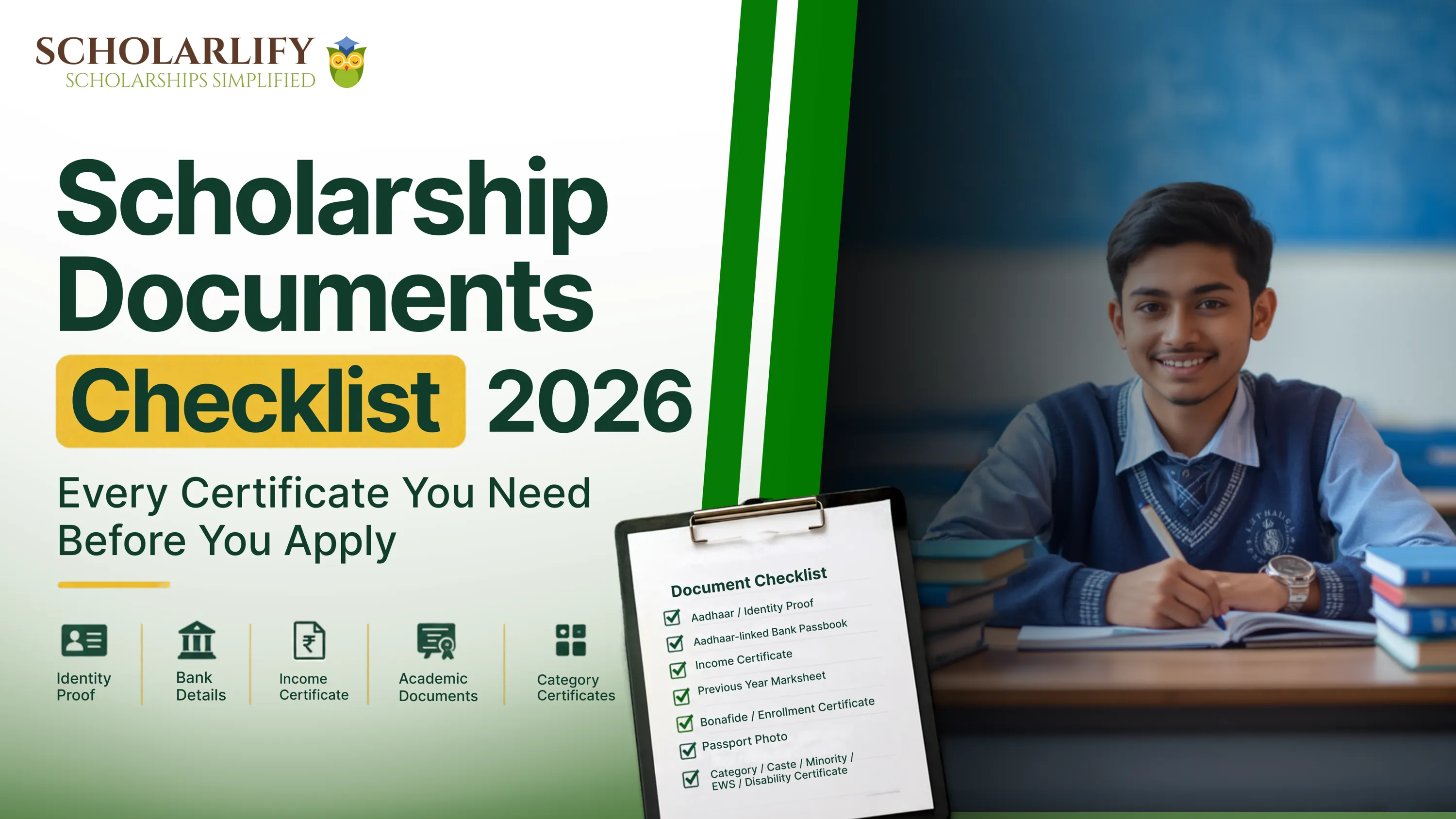
Scholarship Documents Checklist 2026: Every Certificate You Need Before You Apply
One missing or outdated certificate is the most common reason scholarship applications stall at verification, not a weak profile or low marks. This checklist covers the documents nearly every Indian scholarship asks for in 2026-27, plus the category-specific papers you only need if you are applying under SC, ST, OBC, minority, EWS or disability quotas, so you can gather everything before a portal opens rather than scrambling once it does. For NSP-specific requirements, see our NSP Scholarship 2026-27 registration guide, and browse verified opportunities anytime on the Scholarlify homepage.
Quick Facts
| Document | Needed by |
|---|---|
| Aadhaar card, Aadhaar-linked bank passbook | Almost every scheme |
| Income certificate (current financial year) | Almost every scheme |
| Caste / category certificate | SC, ST, OBC, EWS reserved-category schemes |
| Minority or disability certificate | Minority and disability-specific schemes |
| Marksheet, bonafide/admission certificate | All academic-level schemes |
| File format | Clear PDF or JPG, usually under 200-500 KB per file |
Documents every scholarship applicant needs
Regardless of which scholarship you are applying to, most portals ask for a common base set of documents before they look at scheme-specific eligibility.
- Aadhaar card, used for identity verification and, for most central schemes, for One-Time Registration (OTR).
- Aadhaar-linked bank passbook or account details, since almost all scholarship funds move through Direct Benefit Transfer to an Aadhaar-seeded account.
- Income certificate issued by a competent revenue authority, confirming your family income is within the scheme's limit.
- Previous year's marksheet, confirming your last passed examination and current eligibility.
- Bonafide or current enrolment certificate from your school, college or institute.
- Recent passport-size photograph, as specified by the application form
Category-specific documents
On top of the base list, category-based and need-based schemes ask for one additional proof matching the quota you are applying under.
| Category | Additional document | Notes |
|---|---|---|
| SC / ST / OBC | Caste certificate from a competent authority | Name and sub-caste must match other documents exactly; some states require periodic revalidation |
| Minority communities | Minority community certificate or self-declaration as specified by the scheme | Requirements vary by scheme and state |
| EWS | EWS income and assets certificate | A separate certificate from the general income certificate; do not substitute one for the other |
| Persons with disabilities | Disability certificate (UDID or state-issued) | Should state the disability percentage where the scheme specifies a minimum threshold |
| ST applicants on state portals | NSP OTR number | Several state portals, including West Bengal's Oasis, require ST students to complete NSP OTR before applying |
Getting your income certificate right
The income certificate causes more rejections than any other single document, mainly because it is issued by state revenue authorities rather than a central body, so rules differ by state. It must come from a competent authority such as a Tehsildar, Sub-Divisional Magistrate, Block Development Officer or Revenue Circle Officer; a private employer's salary slip or a notarised affidavit is generally not accepted as a substitute. Validity periods vary by state, commonly from one year up to five years, but several scholarship schemes specifically require a certificate from the current or immediately preceding financial year regardless of the state's general validity rule. Check the exact requirement on the scheme's own page rather than assuming your existing certificate is still valid. Female applicants preparing this paperwork alongside women-specific schemes can also see our Wings for Her scholarship guide for scheme-specific document notes.
How to prepare your documents step by step
- Confirm the scheme's exact document list on its official page before you start collecting certificates, since requirements differ between central, state and CSR-backed scholarships.
- Match your name across every document. Your name, date of birth and father's name must be spelled identically on your Aadhaar, marksheets, caste certificate and bank passbook. A single mismatched middle name or initial is enough to trigger a rejection at institute-level verification.
- Get a current-year income certificate if your existing one is outdated or close to expiry, rather than relying on one issued for a previous application cycle.
- Seed your bank account with Aadhaar and confirm the linkage on the NPCI mapper, since Direct Benefit Transfer payments fail silently if this step is missed, even after an application is approved.
- Scan every document clearly as a PDF or JPG within the file-size limit the portal specifies, typically under 200 KB to 500 KB per file. Blurry or oversized scans are a leading cause of document-stage rejection.
Common document mistakes to avoid
- Using an income certificate from a previous academic year when the scheme requires one from the current financial year.
- A spelling or initial mismatch between Aadhaar, marksheets and the bank passbook.
- Submitting a caste certificate that needs revalidation under a state's updated rules without checking first.
- Uploading scanned files that exceed the size limit or are too blurry to read at verification.
- Confusing an EWS certificate with a standard income certificate; they are separate documents for separate purposes.
- Leaving Aadhaar-bank seeding for after the result, which can delay or block fund transfer even after selection.
If you are unsure which documents apply to your specific scheme or category, a one-to-one session through the Scholarlify mentorship programme can help you cross-check your paperwork before you submit.
*Next step: Pull together your Aadhaar, income certificate, category certificate and latest marksheet now, well before any application window opens, so you are ready to submit the moment a scholarship you qualify for goes live. Browse current openings on the Scholarlify scholarship list.*
Frequently Asked Questions
What documents are required for most scholarships in India?
Most scholarships require an Aadhaar card, an Aadhaar-linked bank passbook, a current income certificate, academic marksheets, a bonafide or admission certificate, and a category certificate where applicable.
How long is an income certificate valid for a scholarship application?
Validity depends on the issuing state, commonly one to five years, but several scholarship schemes specifically require a certificate from the current or immediately preceding financial year, so check the scheme's own rule rather than assuming.
Who can issue an income certificate for a scholarship?
A competent revenue authority such as a Tehsildar, Sub-Divisional Magistrate, Block Development Officer or Revenue Circle Officer. A private employer's salary slip or a notarised affidavit is generally not accepted as a substitute.
Do I need a caste certificate for every scholarship?
Only for category-based schemes reserved for SC, ST or OBC students. Merit-based and need-based schemes open to all categories do not require one, but confirm on the specific scheme's eligibility page.
What is the most common reason scholarship applications get rejected over documents?
A name, date of birth or spelling mismatch between the Aadhaar card, academic certificates and bank account, followed by an outdated income certificate and blurry or oversized scanned files.
Can I use the same documents for multiple scholarship applications?
Yes, as long as the documents are still within their validity period and the scheme accepts the same certificate type. Keep clean, correctly sized scanned copies saved so you can reuse them without rescanning each time.